5.31.2009

Do You Know of Any Interactive Online Social Spaces For a School Parent Body

Do you know of any school communities that have an active online space where parents communicate with each other online... perhaps a blog, online forum, social media network? I am trying to help a school community that is interested in having a simple social space where parents can share resources, invitations, ask questions of one another, tell stories, and see what else might emerge. Thanks for sharing any links you know of for other such community sites.

inline... online...
photo by foreversouls

Labels: , ,

posted by ashley

12.02.2008

A Long List of Links

Here's a peek at my internet life over the last few weeks. These are all the tabs open in my browser right now. Some are pages I want to go back to, others I have yet to explore, some are open as references for current projects I am engaged in, and a few I just wanted to share with you! Enjoy and please do tell me if something catches your attention.

Happiness, Well-being, Inspiration
  • 10 Things Science Says will Make You Happy:
    #1 Savor Everyday Moments
    - Pause now and then to smell a rose or watch children at play. Study participants who took time to “savor” ordinary events that they normally hurried through, or to think back on pleasant moments from their day, “showed significant increases in happiness and reductions in depression,” says psychologist Sonja Lyubomirsky.
  • Happiness Can Spread Among People Like a Contagion, Study Indicates:
    The study of more than 4,700 people who were followed over 20 years found that people who are happy or become happy boost the chances that someone they know will be happy. The power of happiness, moreover, can span another degree of separation, elevating the mood of that person's husband, wife, brother, sister, friend or next-door neighbor.

    Experts praised the study as a landmark in the growing body of evidence documenting the influence of personal connections and the importance of positive emotions.... The implications are you can't look at individuals as little entities devoid of their social context."

    "For a long time, we measured the health of a country by looking at its gross domestic product," said Fowler, a political scientist at the University of California at San Diego who co-authored the study. "But our work shows that whether a friend's friend is happy has more influence than a $5,000 raise. So at a time when we're facing such economic difficulties, the message could be, 'Hang in there. You still have your friends and family, and these are the people to rely on to be happy.' "

    "Laughter and singing and smiling tune the group emotionally," Seligman said. "They get them on the same wavelength so they can work together more effectively as group."


  • Benefits of Busy Parents Practicing Self-Care:
    What is involved in self-care? It is useful to look at four dimensions of people's lives in thinking about our range of needs, as well as some activities or techniques that may be readily available for replenishing ourselves. The group was asked to think about people's intellectual, spiritual, emotional/social, and physical needs and to generate ways people might care for themselves with respect to those needs.

    The intellectual dimension is defined as the need to expand one's mind. Spirituality includes uplifting or inspirational aspects of one's life including those that relate to the core value system. The emotional/social aspect involves learning about oneself, especially through relating to others. The physical dimension is concerned with taking care of one's body. According to Ms. Reeves, it is essential to renew ourselves in these four realms, and each person is responsible for self-renewal.
  • Would You Guys Just Knock It Off? 10 Steps to Peace in Your Household from the magazine Half Full: Science for Raising Happy Kids:
    Positive conflict resolution is pretty simple, but unless you are a lot smarter than me (entirely possible) you might need to reference this list a few times to get the hang of it.

    Each time we take kids through those 10 steps, they learn that they can solve problems in ways that make them feel competent and effective. They’ve increased their ability to cooperate, to empathize, and to build strong relationships. So conflict really is a good thing. And so are fights between friends. Why? Conflict provides the fuel for growth we all need to become healthy, happy, and resilient adults.

  • Imogen Heap kept a video blog, i-Blog, while working on her most recent album. I'm slowly making my way through her videos. I've fallen in love with her (I was a fan of her music... but now it's grown to her person!). Her creativity and bubbling enthusiasm are highly contagious and inspirational for me!
  • 10-Minute Practices to Reconnect with Spirit.
    Roger Walsh, the author of Essential Spirituality, was a guest teacher at Integral Institute's Integral Leadership seminars, where he presented the seven essential practices of the world's great Wisdom Traditions. Here is a selection of the experiential exercises led by Roger at those seminars. Each clip is 10-15 minutes long, and is a quick and easy way to recontact the sacred dimensions of this and every moment. Just sit back, relax, and let the next eight minutes be devoted to your higher Self....Experiential exercises led by Roger Walsh
  • Danah Boyd shares a tip for how to deal with your email inbox while on vacation Warning: Email Sabbatical is Imminent:

    No email will be received by danah's ornery INBOX between December 11 and January 19!

    For those who are unaware of my approach to vacation... I believe that email eradicates any benefits gained from taking a vacation by collecting mold and spitting it back out at you the moment you return. As such, I've trained my beloved INBOX to reject all email during vacation. I give it a little help in the form of a .procmail file that sends everything directly to /dev/null. The effect is very simple. You cannot put anything in my queue while I'm away (however lovingly you intend it) and I come home to a clean INBOX. Don't worry... if you forget, you'll get a nice note from my INBOX telling you to shove off, respect danah's deeply needed vacation time, and try again after January 19.
Youth and Education Related

  • Mighty Writers 2008-2009. Students blog their thoughts about why their school, Arbor Heights, should be kept open (and not closed as has been proposed by Seattle Schools).
  • The Guiding Lights Weekend: A playful, experiential conference on the art of mentoring where you will learn concrete ways to motivate, mentor and inspire. The Guiding Lights Weekend is a place to reflect, clarify values, try new things and imagine possibilities. You might just find (or become) the mentor you've been waiting for. Join me January 30th and 31st.

    Experiential workshops. Participatory panels. Talking Circles. Big-Idea Presentations. Community conversations. Awards. Performances. A few surprises and a lot of fun!
Social Change, Taking Action, Leadership
  • The Girl Effect:The powerful social and economic change brought about when girls have the opportunity to participate in their society.
  • Playing for Change: Playing for Change is a multi-media movement created to inspire, connect, and bring peace to the world through music.
  • Best Buy @15 Challenge: 15 teams will wil $10,000 to change their communities. Every week, a voter between the ages of 13 and 20 has the chance to win $500 for a school or organization of their choice and an IPod shuffle for themself!

    I learned about this from the team Richards Rwanda: helping girls in Rwanda get an education. Richards Rwanda was created by Jessica Markowitz when she was in the 6th grade, shes now in eight grade. My family hosted a man named Richard who told me about the genocide hat occurred in 1994. Many children lost their parents and could no longer afford school. Richards Rwanda is an all girl group supporting girls in Rwanda to go to school. We hope to build a school or learning center for the girls we are supporting and the next generations.
  • Charter for Compassion: By recognizing that the Golden Rule is fundamental to all world religions, the Charter for Compassion can inspire people to think differently about religion. This Charter is being created in a collaborative project by people from all over the world. It will be completed in 2009. Use this site to offer language you'd like to see included. Or inspire others by sharing your own story of compassion.
  • Is compassion catching on? Tracing the impact of a historic event: An article in ParentMap Magazine and a little self promotion! “I think it’s a slow process,” says Roots instructor Ashley Cooper. “We have to touch people’s willingness to put compassion into action. In my school community, people are talking more spontaneously about empathy and compassion. To me, that’s a great outcome.

    “But I think it’s really important that we move beyond the Dalai Lama. It was fabulous that he was here, but I really feel like it’s up to us as ‘normal people.’ What are we going to do to make something different happen?

    “I feel hopeful, and I feel like Seattle has that capacity,” Cooper says. “It’s a matter of: How much do people want to do these things that are important — and what are we each willing to do to start making a difference?”
  • Let's Say Thanks In Support of Our Troops: This website gives you an opportunity to send a free printed postcard to U.S. military personnel stationed overseas showing your support and appreciation for their service to our country.
  • Light Up the Night for Equality: On December 20th, we ask that you join us again for a nation-wide demonstration that will make an impact on the private sector. Candlelight vigils will be held at commercial centers in cities across the country in remembrance of the rights that once were for 18,000 marriages, and in honor of the rights that one day will be again - for EVERYONE.
  • Diversitywork.org on A Framework for Transformation and Change: As simple as it may sound, the goal of social justice education is social justice and liberation. Liberation is defined in many ways: freedom, equality, fairness, equal access to resources, respectful treatment, living without the struggles, to name a few. Liberation means human kind will be closer to the achievement of unity. Our society must embark on a transformational process if we our to achieve this goal. Transformation means change, and this change will not come about from well-intentioned people simply wishing it so. Action has to be taken.
  • Project Implicit:
    It is well known that people don't always 'speak their minds', and it is suspected that people don't always 'know their minds'. Understanding such divergences is important to scientific psychology.

    This web site presents a method that demonstrates the conscious-unconscious divergences much more convincingly than has been possible with previous methods. This new method is called the Implicit Association Test, or IAT for short.

    We will ask you (optionally) to report your attitudes toward or beliefs about these topics, and provide some general information about yourself.
  • The Moment of Leadership by Michael Herman: Harrison Owens says, "If you are going to talk about Leadership you have to talk a lot about caring, responsibility, and the point where they cross — which I call Nexus of Caring." Michael's response: "I think what Harrison is calling Nexus of Caring, I would call the Moment of Leadership. The crossing of caring and responsibility that is the cause for motion. And it’s just that small, a moment. Like an invitation...The practice of doing something about the thing you care about. Beginning. The nexus of caring and responsibility. The moment of leadership."
  • Change.gov: Building the community: A guide to comments:
    These online conversations are truly groundbreaking -- no other transition team has ever opened these types of channels of communication with the American people. We're proud of what we've accomplished so far, and look forward to building this dialogue.


    We've read through the thousands of comments posted on Change.gov, and are excited by the volume of participation.

Labels: , , ,

posted by ashley

3.07.2008

Learning From Others

I feel so fortunate that my life includes opportunities to learn from and be with children. Here is a bit of learning that I journaled about the other day. One day as a school counselor, a fortunate human being, sharing, relating and exploring in an educational community.

Today I learned about bravery.

These children are so brave to reach out to someone and ask for help with emotional problems. To accept and surrender to a feeling state that isn't serving them and to vulnerably reach towards another and ask for help.

I learned from the teachers, honoring their bravery to open up and be willing to learn in public, from their peers.

I learned about gossip from a group of third grade girls. They discussed some of the reasons that people talk about other people... For "Something to do", because we're bored, and because it can help to strengthen a bond with another person by talking about a different person. I felt humbled hearing the clarity they expressed of some of the reasons why gossip happens... and how those self-serving intentions can effect the well-being of others.

And I learned about how deeply someone can be touched (I can be touched) by a thank you that bellows out straight from the heart. It amazed me how profoundly I was (and still am) effected when I reached out to a family, helping them to have a resource they needed. I was on the phone with a grandmother when a 5 year old un-promptedly called out a "thank you" that was the most heartfelt, genuine expression of gratitude I have ever heard.

It still echoes through my core, vibrating as my cells, sparking and fueling a current of hope and life's vitality.

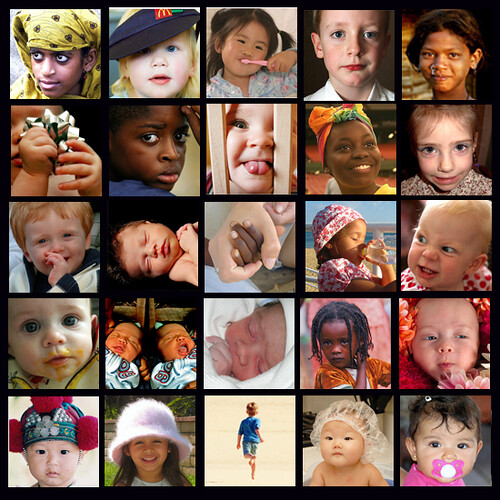
Photo collage Celebrating Children by Cocoabiscuit

Labels: , , , ,

posted by ashley

2.24.2008

Roots of Empathy on CBS

Another taste of Roots of Empathy (with a commercial at the beginning)

Labels: , , ,

posted by ashley

8.13.2007

Roots of Empathy

Tomorrow begins the next amazing (I imagine) training of this summer. I am very fortunate to be participating in the pilot of bringing the successful Canadian based program, Roots of Empathy, to the United States.

I first learned about this program at the Vancouver Dialogues with the Dalai Lama on Educating the Heart (you can listen to those dialogues here). Of all the programs that were presented, Roots of Empathy was the one that most deeply touched my heart as a powerful program with the potential to touch and effect many individuals.

Have a peek at their mission:
The focus of Roots of Empathy in the long term is to build capacity of the next generation for responsible citizenship and responsive parenting. In the short term, Roots of Empathy focuses on raising levels of empathy, resulting in more respectful and caring relationships and reduced levels of bullying and aggression. Part of our success is the universal nature of the program; all students are positively engaged instead of targeting bullies or aggressive children.
The basic structure is that an infant and parent and their relationship are used as the teaching modality for such content as emotional literacy, inclusion, neuroscience, infant development , perspective taking and much more. The infant and parent visit a classroom 9 times throughout the year. A Roots of Empathy instructor goes to the classroom with them and the week before and the week after the parent/baby visit. A synchronistic chain of events has lead to the opportunity for me to be a Roots of Empathy instructor at a local public school. (I'm very excited!)

Here is my response on the application to the question of Why do you want to become a Roots of Empathy Instructor?
I am deeply inspired by this program and how it uses relationships as the core of its teaching, invites and facilitates community connection and belonging, teaches through modeling and experiencing, and has potential to reach a wide variety of people (students, parents, teachers… of all types of diversity). I would like to become an instructor because I would like to see this program touch as many people as possible and therefore I would like to help facilitate that sharing and touching!
Here we go!

On a separate but related note, I'm having a hard time figuring out what to write here these days. There is so much pouring through me on both a personal level and a professional level that I've been clueless about where and how to jump in and share with you (and a little uncertain as to who 'you' are these days). If there is anything that you are curious about from these trainings or anything else that has been going on in my life, please feel free to ask me questions and maybe help inspire forward some writing here! Thanks.

Labels: , , ,

posted by ashley

5.06.2007

Educating for Wholeness

I recently updated Educating for Wholeness. There you'll find perspectives from parents, teachers and students as well as learning activities that I facilitate with students and parents. Have a peek:

Labels: , , ,

posted by ashley

10.14.2006

Creativity, Education, Intrinsic Strengths, Innate Curiosity and Play

Some educational and parenting resources for you:

A MUST see, hysterical and insightful TEDtalk with Sir Ken Robinson
Sir Ken Robinson is author of Out of Our Minds: Learning to be Creative, and a leading expert on innovation and human resources. In this talk, he makes an entertaining (and profoundly moving) case for creating an education system that nurtures creativity, rather than undermining it. (Recorded February, 2006 in Monterey, CA.)
Thank you Christoph for directing me to this talk.

An interesting NY Times article, So the Torah is a Parenting Guide?
“Indulged, coddled, pressured and micromanaged on the outside, my young patients appeared to be inadvertently deprived of the opportunity to develop an inside,” she writes in her book. “They lack the secure, reliable, welcoming internal structure that we call the ‘self.”’ ...

There is a Hasidic saying that Mogel quotes, “If your child has a talent to be a baker, don’t ask him to be a doctor.” By definition, most children cannot be at the top of the class; value their talents in whatever realm you find them. “When we ignore a child’s intrinsic strengths in an effort to push him toward our notion of extraordinary achievement, we are undermining God’s plan,” Mogel writes.
Which leads me to aPsychology Today article on the Sudbury Valley school:
At Sudbury Valley School, there's no other way to learn. The 38-year-old day facility in Framingham, Massachusetts, is founded on what comes down to a belief about human nature—that children have an innate curiosity to learn and a drive to become effective, independent human beings, no matter how many times they try and fail. And it's the job of adults to expose them to models and information, answer questions—then get out of the way without trampling motivation. ...

Play—it's by definition absorbing. The outcome is always uncertain. Play makes children nimble—neurobiologically, mentally, behaviorally—capable of adapting to a rapidly evolving world. That makes it just about the best preparation for life in the 21st century. Psychologists believe that play cajoles people toward their human potential because it preserves all the possibilities nervous systems tend to otherwise prune away. It's no accident that all of the predicaments of play—the challenges, the dares, the races and chases—model the struggle for survival. Think of play as the future with sneakers on.

Labels: , , , ,

posted by ashley

10.01.2004

things we can and cannot control

as an elementary school counselor, i get to engage with children in many enriching conversations. discussing life skills has always been a topic that i find incredibly valuable to dialogue with children. this month's guidance lesson with grades 2-4 was on changes that happen in our lives.
things in our life are constantly changing. some changes we can control and some changes we can't control. can you think of some things that happen in your life that you can or cannot control?
the class, sitting in a circle, passes around a container of dried lima beans, a can, and a bug cage. each child takes out a lima bean and, if they feel comfortable, shares with the group either one thing that they can control (putting a bean in the can) or one thing that they cannot control (putting a bean in the cage).

CAN

my behavior
my thoughts
my life
how much sleep i get
what i wear
my little brother
my dog

CAN'T

my mom and dad fighting
my grandfather dying
my parents getting a divorce
someone being mean to me
having to move
my little sister annoying me
my dog jumping on me
the weather

what has been most noteworthy to me in these revealing discussions is how much happens in children's lives that they have absolutely no control over. in most classrooms the can would have 3-5 beans and the cage would be full. as an adult, can you imagine swimming through your days from one place to another, having to strictly follow and succumb to events in your life in which you have no control? can you imagine that feeling of complete helplessness, the extreme lack of control of the course of your day, your life?

then i start to think about adults... and the events, emotions, places of being in which we feel like we have no control. i was listening to someone explain the tendency of a child to just giggle uncontrollably when they are uncomfortable, anxious, or nervous. the child would giggle, giggle, giggle, until no breath was left... take a deep breath.... and then return to giggling, giggling, giggling. listening to this description made me think of addictions. how we constantly return to our addictions (our old habits) because they sooth us. they are often all we know as a means of coping with that which we are experiencing inside. and as is the nature of addictions, we fall into the habit of replaying the looping scenario of needing something and indulging in the addiction that provides that which we feel like we need (comfort, familiarity, calmness, numbness, security, support, companionship, etc.). this process becomes a fixation and often it takes such a strong hold on us that it seems as though we have no control over it. it is simply happening to us.... and we put a bean in the cage, feeling trapped and helpless.

in the guidance class, the next round of discussion is coming up with ideas of ways to respond to situations we can't control. if many children mention that their parents argue a lot, the group shares suggestions of things you can do when you're parents are fighting
go into your room and draw a picture that makes you feel good, go to a friend's house, ask them to stop, go to your safe-secret space and relax there, make up a skit with your sister of what they look like when they're fighting "they really look just like kids!"
this part is my favorite as i am always in awe of the children's insight and their ability to help one another. we then pass the can around without the cage and re-emphasize things we have control of in our lives.

feel free to drop a bean in the can or cage if you're so inspired.

Comments:

Ashley, you are such a hero. I'm sure you realize how important the work you're doing is, but I wish more people would. The lessons you're teaching (and learning yourself, it seems!) about community building and supporting others and interaction are so, so significant. Thank you so much for posting this: you've given me hope.


GravatarYup kids, and adults too...in my work this is the essence of colonization: how little control we feel we have over our lives. Decolonization is the process of opening the space of options for that which we can control, and getting busy with doing that to make more of it.


GravatarIn a related vein, it's true that kids seem to have so little control in their lives, but they have many more options that adults. For example, when I take my kids to Grandma's house and we visit the sitting room, I can see about two options for the kids: sitting there quietly or leaving My kids on the other hand, have a million options. Grandma's sitting room is a theme park waiting to be played in, but for me all of that is anxiety riddled. "Don't touch, don't jump, don't knock over..."

The trick in supporting opening relationships is to negotiate in a way that leaves the kid's options intact and both of our needs met. Kids will always win that negotiation, because in any negotiation, whoever has the most options wins. So as an adult, my kids are always challenging me to find more options, rather than limiting theirs.


GravatarDecolonization is the process of opening the space of options for that which we can control

YEAH! and so much of that work is an inner journey. internally we have to reframe, restructe a perspective that has been given many reasons, justifications, moments in history to believe that there is 'no control.' i see the role of those who already know this as one of acting as companions and role models for the a-ha that the open space already exists and there is room for us to have immense control. does this fit in with your mapping of decolonization?


Gravataras for the adults and the kids at grandma's, isn't that just a matter of perspective that the adults only two options? adults can go and ask questions about the trinkets and pictures and paintings and such. eh?

as for the anxiety... that's so not a part of parenting that i'm looking forward to! doesn't it make you just not want to visit places where there are so many child-instigated-disasters waiting to happen?

for me leaving the kids options in tack and meeting both adult and child's needs is wrapped up in setting limits and offering potent choices. like you say the one with the most choices wins, and the key seems to be offering joices that are a win-win for both adults and children.

your kids are so lucky that they've got you for a dad!


Gravatarhi guys! this is brilliant ashley. and congrats on the new address! i'm posting here because i can! love from kathmandu. m

Labels: , , ,

posted by ashley

This page is powered by Blogger. Isn't yours?